
As part of our ongoing Middle East market update, we are maintaining the revised structure used in our previous communication: key changes since the last update, followed by broader market and operational implications.
Given the sustained structural nature of the disruption and no confirmed operational normalization yet, we continue with a biweekly updates cadence to focus on material developments.
While a tentative diplomatic agreement has been announced that may allow a phased reopening of the Strait of Hormuz, subject to implementation and confirmed safe/insured transits, recent incidents highlight that the situation remains volatile and subject to rapid change. Shipping, insurance, airspace, and energy-market recovery continue to be gradual and subject to short-notice developments.
Operational planning across both air and ocean remains driven by security access, insurance approvals, port feasibility, carrier acceptance, and routing availability.
To support visibility on current market behavior, we have also included a supplementary PDF with Xeneta airfreight spot rate data illustrating recent rate development and volatility trends across key lanes.
What Has Changed Since Last Update
- The tentative stabilization seen following the June ceasefire agreement has reversed, with renewed military exchanges between the United States and Iran and reported attacks on commercial vessels transiting the Strait of Hormuz.
- Commercial shipping volumes through the Strait of Hormuz have declined again as shipowners and operators reassess operational and security risks.
- Several carriers and vessel operators continue to apply enhanced security procedures, routing adjustments, and voyage-specific risk assessments before accepting Gulf-related shipments.
- War risk exposure has increased following the latest incidents, with insurers continuing to apply strict underwriting requirements and voyage approvals.
- Oil prices and transport-related costs have shown renewed volatility due to concerns regarding the security of Hormuz transits and regional energy flows.
- Airfreight networks have remained operational, but carriers continue to closely monitor regional airspace developments and retain contingency routing measures.
- Security concerns in the Red Sea remain present, with recent reports of attacks on commercial vessels off the Yemeni coast reinforcing ongoing caution among operators.
- Market visibility remains limited, and conditions continue to be susceptible to rapid deterioration following any further regional escalation.
What Has Not Changed
- No confirmed return to stable, predictable operations.
- Carrier acceptance remains selective and subject to route, cargo type, destination, and security approval.
- Gulf hub planning still requires shipment-level confirmation before dispatch.
- Red Sea and Suez planning remains subject to security assessment, carrier routing decisions, and potential Cape of Good Hope diversions.
- Elevated cost exposure persists across freight, fuel, insurance, surcharges, storage, and inland transfer.
- Insurance remains a key determinant of routing feasibility and capacity availability.
Air Freight – Capacity & Network
- Airfreight operations across the Middle East remain functional, however airlines continue to closely monitor the evolving security situation and maintain contingency plans for potential airspace restrictions or route adjustments.
- Recent military activity across the Gulf region has increased operational uncertainty, with carriers continuing to conduct dynamic risk assessments for flights operating into, out of, or over the Middle East.
- While large-scale airspace closures are not currently in effect, selected carriers continue to use alternative routings to avoid higher-risk areas, resulting in longer flight times and reduced schedule flexibility on certain trade lanes.
- Hub airports in the Gulf remain operational, but short-notice schedule changes, flight cancellations, and capacity reallocations remain possible should regional tensions escalate further.
- EASA conflict-zone guidance remains in place for Iran, Iraq, and Lebanon, requiring operators to maintain enhanced risk assessments and operational controls.
Ocean Freight & Routing Environment
- Hormuz-related ocean movements remain subject to security clearance, routing authorization, and insurance approval.
- Following recent incidents, vessel traffic through the Strait of Hormuz has again reduced, resulting in continued uncertainty for Gulf supply chains.
- Several carriers continue to apply booking restrictions, alternative gateway solutions, or multimodal routings for Gulf cargo.
- Alternative gateways such as Khor Fakkan, Fujairah, Sohar, Salalah, Jeddah, and Aqaba remain important contingency options.
- Port congestion remains a risk at key alternative gateways, particularly where cargo is discharged and moved inland or cross-border.
- Cape of Good Hope routing remains relevant for Red Sea/Suez-affected lanes where carriers determine risk remains elevated.
- Red Sea security risks remain present, and operators continue to assess exposure to potential maritime attacks in the Bab El-Mandeb and Gulf of Aden regions
Marine Insurance
- War risk pricing remains elevated and route-specific and continues to be a key operational constraint.
- Premiums remain significantly above pre-crisis levels and are highly dependent on vessel profile, routing, and insurer appetite.
- Voyage-based approvals, short validity windows, and case-by-case underwriting remain standard.
- Insurance approval continues to directly affect routing feasibility, carrier acceptance, and sailing availability.
Fuel Supply & Cost Pressure
- Oil and bunker markets remain highly sensitive to developments in the Strait of Hormuz, resulting in continuing price volatility.
- Full normalization remains dependent on sustained stability, consistent shipping access, and improved insurance conditions.
- Freight pricing remains exposed to bunker adjustment factors, emergency freight charges, war risk surcharges, terminal storage, inland transfer, and demurrage/detention.
As part of our ongoing Middle East market update, we are maintaining the revised structure used in our previous communication: key changes since the last update, followed by broader market and operational implications.
Given the sustained structural nature of the disruption and no confirmed operational normalization yet, we continue with a biweekly updates cadence to focus on material developments.
While a tentative diplomatic agreement has been announced that may allow a phased reopening of the Strait of Hormuz, subject to implementation and confirmed safe/insured transits, recent incidents highlight that the situation remains volatile and subject to rapid change. Shipping, insurance, airspace, and energy-market recovery continue to be gradual and subject to short-notice developments.
Operational planning across both air and ocean remains driven by security access, insurance approvals, port feasibility, carrier acceptance, and routing availability.
To support visibility on current market behavior, we have also included a supplementary PDF with Xeneta airfreight spot rate data (February–May versus January baseline), illustrating recent rate development and volatility trends across key lanes.
What Has Changed Since Last Update
- A tentative reopening framework for the Strait of Hormuz was followed by renewed escalation, including a recent incident involving a commercial vessel (25–26 June) and subsequent military response, confirming that conditions remain unstable.
- Iranian authorities have indicated that vessels are expected to follow designated transit routes and coordination procedures, with increased enforcement risk in case of non-compliance.
- Strait of Hormuz traffic has shown short-term recovery followed by renewed slowdowns, with overall volumes still below pre-crisis levels and operators continuing to proceed cautiously.
- The situation remains sensitive to further escalation, with recent events demonstrating the potential for rapid deterioration in operating conditions.
- Localized vessel queuing and anchorage delays have been reported in parts of the Oman/UAE region, driven by controlled transit flows and scheduling variability.
- War risk and insurance conditions remain elevated, continuing to influence carrier routing decisions and willingness to operate.
- Freight markets continue to show volatility, with elevated rate levels and disruption-related surcharges observed in recent weeks.
- Airfreight networks continue to normalize gradually, but persistent airspace constraints and rerouting requirements are still impacting flight times and schedule reliability.
What Has Not Changed
- No confirmed return to stable, predictable operations.
- Carrier acceptance remains selective and subject to route, cargo type, destination, and security approval.
- Gulf hub planning still requires shipment-level confirmation before dispatch.
- Red Sea and Suez planning remains subject to security assessment, carrier routing decisions, and potential Cape of Good Hope diversions.
- Elevated cost exposure persists across freight, fuel, insurance, surcharges, storage, and inland transfer.
- Insurance remains a key determinant of routing feasibility and capacity availability.
Air Freight – Capacity & Network
- Capacity has improved versus the peak disruption period, but recovery remains uneven across the region.
- Operators continue to apply rerouting around restricted or sensitive airspace, resulting in longer flight times on selected corridors.
- EASA conflict-zone guidance remains in place for Iran, Iraq, and Lebanon, requiring ongoing risk assessments.
- Schedule changes, controlled booking acceptance, and transit delays remain possible.
- Alternative routings via Europe, India, and selected regional gateways may continue to be required.
Ocean Freight & Routing Environment
- Hormuz-related ocean movements remain subject to security clearance, routing authorization, and insurance approval.
- Transits remain inconsistent, with stop-start flows and traffic levels below normal benchmarks, creating planning uncertainty.
- Several carriers continue to apply booking restrictions, alternative gateway solutions, or multimodal routings for Gulf cargo.
- Alternative gateways such as Khor Fakkan, Fujairah, Sohar, Salalah, Jeddah, and Aqaba remain important contingency options.
- Port congestion remains a risk at key alternative gateways, particularly where cargo is discharged and moved inland or cross-border.
- Cape of Good Hope routing remains relevant for Red Sea/Suez-affected lanes where carriers determine risk remains elevated.
Marine Insurance
- War risk pricing remains elevated and route-specific and continues to be a key operational constraint.
- Premiums remain significantly above pre-crisis levels and are highly dependent on vessel profile, routing, and insurer appetite.
- Voyage-based approvals, short validity windows, and case-by-case underwriting remain standard.
- Insurance approval continues to directly affect routing feasibility, carrier acceptance, and sailing availability.
Fuel Supply & Cost Pressure
- Oil and fuel prices have eased following recent diplomatic developments but remain volatile due to ongoing security risks.
- Full normalization is expected to take time due to tanker positioning, insurance constraints, and broader regional instability.
- Freight pricing remains exposed to bunker adjustment factors, emergency freight charges, war risk surcharges, terminal storage, inland transfer, and demurrage/detention.
What Has Changed Since Last Update
- A tentative de-escalation framework has been announced, including a potential reopening of the Strait of Hormuz, but implementation remains unconfirmed and operational recovery is expected to take time.
- Strait of Hormuz transits remain operationally constrained pending confirmed reopening, with prior traffic levels sharply reduced and operators continuing to assess security and insurance exposure.
- Alternative gateway routing remains active and case-by-case contingency routings, including use of Khor Fakkan, Fujairah, Sohar, Salalah, Jeddah, Aqaba, and selected landbridge solutions, subject to capacity and cargo acceptance.
- Port congestion continues at key alternative gateways, particularly Khorfakkan, Jeddah, Omani ports, and eastern UAE ports, with onward movement delays and increased demurrage/detention exposure.
- Airfreight conditions are improving but remain disruption-sensitive, with most airspace open in some form, but longer routings, security corridor adjustments, and uneven airport recovery still affecting schedules.
- Fuel and energy prices have eased from recent peaks but remain above pre-crisis levels, with continued volatility expected until flows, refining, and insurance confidence normalize.
What Has Not Changed
- No confirmed return to stable, predictable operations.
- Carrier acceptance remains selective and subject to route, cargo type, destination, and security approval.
- Gulf hub planning still requires shipment-level confirmation before dispatch.
- Red Sea and Suez planning remains subject to security assessment, carrier routing decisions, and potential Cape of Good Hope diversions.
- Elevated cost exposure persists across freight, fuel, insurance, surcharges, storage, and inland transfer.
- Insurance remains a key determinant of routing feasibility and capacity availability.
Air Freight – Capacity & Network
- Capacity has improved versus the peak disruption period, but recovery remains uneven across the region.
- Operators may continue using longer routings due to security-related corridor adjustments.
- European Union Aviation Safety Agency (EASA) latest active conflict-zone bulletin still recommends that operators to not operate within the affected airspace of Iran, Iraq and Lebanon at all flight levels and altitudes, and maintain close risk assessments across the wider Middle East and Persian Gulf region.
- Schedule changes, controlled booking acceptance, and transit delays remain possible.
- Alternative routings via Europe, India, and selected regional gateways may continue to be required.
Ocean Freight & Routing Environment
- Hormuz-related ocean movements remain subject to security clearance, insurance approval, and carrier acceptance.
- Several carriers continue to apply booking restrictions, alternative gateway solutions, or multimodal routings for Gulf cargo.
- Alternative gateways such as Khor Fakkan, Fujairah, Sohar, Salalah, Jeddah, and Aqaba remain important contingency options.
- Port congestion and onward transport delays remain a key operational risk, especially where cargo is discharged at alternative gateways and moved inland or cross-border.
- Cape of Good Hope routing remains relevant for Red Sea/Suez-affected lanes and may continue where carriers determine that Red Sea transit risk is unacceptable.
Marine Insurance
- War risk pricing remains elevated and route-specific.
- Current market indications vary materially by vessel, flag, cargo, owner, voyage profile, and insurer appetite; reported Hormuz-related war risk pricing has been around 0.8%–1.5% of hull value in certain cases, with higher outcomes possible for higher-risk exposures.
- Voyage-based approvals, short validity windows, and case-by-case underwriting remain standard.
- Insurance approval continues to directly affect routing feasibility, carrier acceptance, and sailing availability.
Fuel Supply & Cost Pressure
- Oil and fuel prices have eased following the latest diplomatic announcement, but they remain above pre-crisis levels.
- Full restoration of flows and pricing normalization may take months, particularly due to tanker positioning, refinery logistics, insurance availability, and production restart timelines.
- Freight pricing remains exposed to bunker adjustment factors, emergency freight charges, war risk surcharges, terminal storage, inland transfer, and demurrage/detention.
As part of this update, we have maintained the revised structure introduced previously. We begin by outlining what has changed and what has not changed since the last communication, followed by broader market and operational context.
Given the sustained structural nature of the disruption and the absence of short-term normalization drivers, we continue with a biweekly update cadence to focus on material developments.
We would like to provide this update on developments related to the ongoing escalation in the Middle East and its impact on global transportation networks. Over the past two weeks, there has been no material improvement in operational conditions. While diplomatic positioning and temporary de-escalation efforts continue, maritime security risk, enforcement activity, and insurance constraints remain firmly in place, preventing any meaningful normalization.
Recent developments further confirm that the disruption is structural and embedded in carrier and insurer decision-making, rather than a short-term volatility event. Operational planning continues to be driven by security access, insurance approval, and routing feasibility, with knock-on effects across both ocean and air networks globally.
To support visibility on current market behavior, we have also included a supplementary PDF with Xeneta airfreight spot rate data (January–May), illustrating recent rate development and volatility trends across key lanes.
What Changed vs Last Week
- Strait of Hormuz conditions further entrenched: Transit levels remain extremely reduced (down >90% vs. normal levels), with only limited and selective movements taking place. Clearance remains unpredictable, with vessels facing last-minute approvals, refusals, or rerouting, and continued buildup of vessels outside the Gulf.
- Security risk remains active (not stabilizing): Ongoing incidents involving vessel attacks, harassment, and military activity confirm that risk exposure remains immediate, with more than 40 maritime incidents recorded since the start of the conflict.
- Carrier avoidance now structural: Major carriers are no longer planning near-term return to Gulf routings, maintaining diversions and suspended services as part of standard network design.
- Congestion shifting rather than easing: Congestion continues to build across alternative gateways (Oman, Saudi Arabia, India, UAE east coast) due to rerouting and diversion flows. Dwell times and backlog remain elevated.
- Airfreight volatility increased again: Gulf hub operations remain active but unstable, with capacity sensitive to escalation, short-notice schedule changes, and longer booking lead times.
- Insurance constraints tightening in practice: War risk insurance remains available but on voyage-specific approvals with short validity, and premiums remain significantly elevated versus pre-crisis levels.
- Fuel and cost pressure sustained: Ongoing disruption to energy flows continues to support elevated and volatile fuel costs, feeding through into global transport pricing.
What Has Not Changed
- No return to stable operations: Planning remains driven by security, insurance, and regulatory constraints.
- Gulf hubs remain unreliable for routine planning: Limited operations continue but are not scalable or predictable.
- Strait of Hormuz remains constrained: Transits remain highly selective and risk driven.
- Cape routing remains the norm: Most carriers continue to avoid or limit Red Sea / Suez routings, adding ~10–14 days transit time.
- Cost pressure remains structural: Elevated premiums, fuel costs, and short rate validity continue.
- Insurance remains a gating factor: It directly determines routing feasibility and capacity availability.
Air Freight – Capacity & Network
Air cargo operations remain constrained and highly volatile:
- Movement remains restricted by airspace controls and security routing
- Capacity via Gulf hubs remains operational but unstable and disruption-sensitive
- Short-notice schedule changes and rollovers persist
- Alternative routing via Europe and India increasingly utilized
- No sustained, system-wide normalization observed
Congestion and backlog persist across UAE hubs, with controlled booking acceptance and continued schedule volatility.
Airspace & Operating Environment
- Iran remains closed
- Iraq and Syria remain operational with restrictions
- Israel remains approval-based
- UAE and Qatar operate under controlled corridors
- Saudi Arabia and Oman serve as key contingency routes
Operational reliability and capacity availability remain inconsistent.
Maritime Chokepoints
Strait of Hormuz:
- Transit volumes remain at a fraction of normal levels
- Movements are limited, selective, and risk-driven
- Backlogs persist outside the Gulf
- Security conditions remain the primary constraint
Red Sea / Bab El Mandeb:
- Risk remains elevated with no sustained reopening
- Most carriers continue to avoid or limit transits
- Cape diversion remains standard (+10–14 days)
- Secondary congestion continues to build globally
Ocean Freight – Current Status
- Hormuz transits remain extremely limited
- Red Sea continues to be treated as elevated risk
- Most carriers maintain avoidance of Suez routings
- Schedule reliability remains under pressure due to rerouting and congestion
Disruption continues to be absorbed through extended transit times and increased costs rather than restored capacity.
Marine Insurance
War risk premiums remain elevated
- Typical ranges around ~0.8%–1%+ of hull value (higher for exposed vessels)
- Extreme cases reported significantly higher depending on risk profile
Voyage-based underwriting and short validity windows (≤7 days, often shorter)
Fuel Supply & Cost Pressure
- Fuel costs remain elevated and volatile
- Disruption to oil flows via Hormuz (historically ~20–25% of global seaborne oil) continues to affect pricing
- No confirmed shortages, but supply risk remains a key market driver
As part of this week’s update, we have maintained the revised structure introduced last week. We begin by outlining what has changed and what has not changed since the previous update, followed by broader market and operational context should you not have seen earlier communications.
We would like to provide this week’s update on developments related to the ongoing escalation in the Middle East and its impact on global transportation networks. While a temporary US–Iran ceasefire remains nominally in place, no sustained or repeatable improvement has translated into stable or predictable air or ocean transport operations. Conditions remain fragile, with continued maritime security incidents, enforcement activity, and insurance constraints preventing any meaningful operational normalization.
Airspace risk management, maritime corridor disruption, elevated insurance costs, and sustained fuel price pressure continue to structurally affect global logistics flows. Impact remains most pronounced across Asia–Europe, Europe–Middle East, and trans‑Gulf trade lanes, with secondary effects increasingly visible across Asia–North America and Europe–North America corridors as disruption persists.
What Changed vs Last Week
- Ceasefire effectiveness weakened further: While the temporary US–Iran ceasefire remains nominally in place, it has not translated into operational normalization. During the past week, additional maritime security incidents and enforcement activity involving commercial vessels further reduced confidence in near‑term stabilization. Transport conditions remain clearance‑based rather than market‑driven.
- Strait of Hormuz risk perception hardened: Following limited and cautious movements earlier in April, recent incidents and enforcement activity reinforced insurers and carriers’ reluctance to support Hormuz transits. Commercial movements remain highly selective, clearance‑based, and exposed to sudden reversal rather than trending toward reopening.
- No scalable air capacity recovery despite technical airspace availability: Iraq, Syria, and Bahrain remain technically open; however, no scalable or dependable air cargo capacity recovery has occurred. Safety advisories, insurance conditions, and regulatory uncertainty continue to prevent practical utilization at scale.
- Red Sea risk reaffirmed: Iran‑aligned Houthi warnings regarding Red Sea and Bab El‑Mandeb transit were reiterated during the past week. Several carriers that had cautiously tested limited Red Sea transits have reverted once again to Cape of Good Hope routings.
- Dual‑chokepoint risk embedded in carrier planning: The risk of simultaneous disruption at both the Strait of Hormuz and Bab El‑Mandeb has shifted from analytical concern to embedded operational reality, materially shaping routing, deployment, and pricing decisions on Asia–Europe trade lanes.
- Insurance constraints tightened further: Following renewed maritime security incidents, war‑risk insurance conditions hardened again, with shorter quotation validity, increased reliance on voyage‑specific approvals, and heavier influence on routing and capacity decisions.
What Has Not Changed
- No return to stable operations: Despite the ceasefire, global air and ocean transport networks remain structurally unstable. Planning continues to be driven by security, insurance, and regulatory constraints rather than normal commercial scheduling.
- Gulf hubs remain unreliable: Dubai, Abu Dhabi, and Doha cannot yet be relied upon as routine cargo hubs, with movements subject to case‑by‑case approval, frequent rescheduling, and sudden cancellations.
- Strait of Hormuz remains constrained: Commercial transits continue to be limited, selective, and clearance‑based. Routing feasibility remains driven primarily by war‑risk insurance acceptance, sanctions compliance, and security exposure rather than navigational availability.
- Cape of Good Hope diversions remain the norm: Most mainline ocean carriers continue to avoid the Red Sea and Suez Canal, resulting in extended transit times, reduced schedule reliability, and persistent equipment imbalance.
- Cost pressure remains structural: Elevated war‑risk premiums, fuel surcharges, and shortened rate‑validity windows continue to apply across both air and ocean freight, with no sustained easing observed.
- Insurance remains a gating factor: Insurance acceptance continues to directly determine whether routes, vessels, or flights are commercially viable, limiting capacity recovery even where corridors are technically open.
Air Freight – Capacity & Network Status
Air cargo operations in and around the Middle East remain severely constrained. Limited technical airspace reopening has not translated into reliable or scalable capacity.
- Selected Gulf carriers (including Emirates, Etihad, and Qatar Airways) continue to operate highly restricted, approval‑based movements, primarily for aircraft repositioning, repatriation, and pre‑approved freighter services.
- Operations remain subject to regulatory oversight, controlled routings, fuel considerations, and short‑notice cancellations.
- The majority of belly and dedicated freighter capacity via traditional Gulf hubs remains unavailable for routine cargo planning.
- Dubai (DXB/DWC), Abu Dhabi (AUH), and Doha (DOH) continue to operate on case‑by‑case approval and cannot yet be considered reliable cargo hubs.
- Regional air cargo capacity through the Gulf remains materially below pre‑conflict levels, with no sustained recovery observed.
Cargo backlogs persist across the UAE; with congestion most pronounced in Dubai and Sharjah and overflow increasingly absorbed by Abu Dhabi. Booking acceptance remains carrier‑controlled, and schedule volatility should be expected.
Middle East Airspace & Operating Environment
The regional aviation environment remains fluid and operationally fragile.
- Iran and Kuwait remain closed to civilian air traffic.
- Iraq, Syria, and Bahrain have technically reopened airspace; however, airline utilization remains limited due to safety advisories and insurance constraints.
- Israeli airspace remains approval‑only, with limited government‑sanctioned movements.
- UAE and Qatari airspace remain partially available via tightly controlled corridors, subject to capacity caps.
- Saudi Arabia and Oman continue to function as critical contingency corridors under elevated ATC and routing load.
Even where airspace is technically open, operational reliability, insurance acceptance, and uplift availability remain inconsistent and should not be assumed for routine routing.
Maritime Chokepoints – Strait of Hormuz, Red Sea & Bab El‑Mandeb
- The US–Iran ceasefire remains in effect but has not resulted in normalization of maritime movements.
- The Strait of Hormuz remains effectively clearance‑based, influenced by Iranian controls, US enforcement activity, and war‑risk insurance acceptance.
- Commercial vessel movements remain limited and highly selective, with continued security incidents influencing carrier behavior.
- Commercial shipping through Hormuz continues to be treated as a high‑risk operating environment.
- Routing decisions remain driven by insurance, sanctions compliance, and security exposure rather than navigational feasibility alone.
Red Sea & Bab el‑Mandeb – Renewed Escalation Risk
- Iran‑aligned Houthi forces reiterated warnings regarding Bab el‑Mandeb during the past week.
- Analysts continue to caution against a dual‑chokepoint risk scenario, with Hormuz and Bab el‑Mandeb simultaneously constrained.
- Asia–Europe routings via Suez remain volatile.
- Several carriers that tested limited Red Sea transits have reverted to Cape of Good Hope routings.
- These diversions add approximately 10–14 days of sailing time and continue to create secondary congestion at select African bunkering and transshipment ports.
- Schedule reliability and destination ETA confidence remain materially degraded.
Ocean Freight – Current Status
Despite the ceasefire, maritime conditions remain materially disrupted:
- Hormuz transits remain selective and clearance‑based
- Red Sea and Bab El‑Mandeb routings are again viewed as elevated‑risk
- Most mainline carriers continue to avoid Suez routings
- Global schedule reliability and equipment balance remain under pressure
Disruption continues to be absorbed primarily through cost escalation rather than full capacity withdrawal, with services operating at materially higher fuel‑ and risk‑adjusted cost levels.
Marine Insurance – War‑Risk Premiums
Insurance conditions have not eased.
- War‑risk premiums remain elevated across affected corridors
- Reported premium levels generally remain in the range of approximately:
- ~1–3% of vessel value per transit for most affected routings
- Higher pricing possible for exceptional or high‑risk single‑voyage scenarios
- Quotation validity windows have shortened further, in some cases to 24 hours or less
Insurance acceptance remains a direct determinant of routing feasibility, voyage approval, and final cost.
Fuel Supply & Cost Pressure – Europe & Asia
Fuel continues to represent a central operational and pricing risk.
- European jet fuel prices remain elevated
- Europe’s structural reliance on imported jet fuel leaves the market exposed to geopolitical disruption
- Industry bodies continue to warn of elevated risk to physical availability should Hormuz disruption persist, though no confirmed systemic shortages have materialized to date
- Airlines and airports are actively contingency‑planning around both fuel availability and pricing volatility
We would like to provide this week’s update on developments related to the ongoing escalation in the Middle East and its impact on global transportation networks. While a temporary US–Iran ceasefire remains nominally in place, no sustained or reliable improvement has translated into stable or predictable air or ocean transport operations. Conditions remain fragile, with continued maritime security incidents and enforcement actions preventing any meaningful operational normalization.
Airspace risk management, maritime corridor disruption, elevated insurance costs, and sustained fuel price pressure continue to structurally affect global logistics flows. The impact remains most pronounced across Asia–Europe, Europe–Middle East, and trans‑Gulf trade lanes, with increasing secondary effects now visible across Asia–North America and Europe–North America corridors as disruption persists.
What Changed vs Last Week
- Ceasefire effectiveness weakened further: While the temporary US–Iran ceasefire remains in place, it has not translated into operational normalization. During the past week, additional maritime incidents and enforcement activity involving commercial vessels further reduced confidence in any near‑term stabilization. Transport conditions remain clearance‑based rather than market‑driven.
- Strait of Hormuz risk perception hardened: Following limited and cautious movements earlier in April, recent incidents and enforcement activity reinforced insurers and carriers’ reluctance to support Hormuz transits. Commercial movements remain highly selective, clearance‑based, and exposed to sudden reversal rather than trending toward reopening.
- No scalable air capacity recovery despite technical airspace availability: Iraq, Syria, and Bahrain remain technically open; however, no scalable or dependable air cargo capacity recovery has occurred. Safety advisories, insurance conditions, and regulatory uncertainty continue to prevent practical utilization at scale.
- Red Sea risk reaffirmed: Iran‑aligned Houthi warnings regarding Red Sea and Bab El Mandeb transit were reiterated during the past week. Several carriers that had cautiously tested limited Red Sea transits have reverted once again to Cape of Good Hope routings.
- Dual‑chokepoint risk now embedded in carrier planning: The risk of simultaneous disruption at both the Strait of Hormuz and Bab El Mandeb has shifted from analytical concern to embedded operational reality, materially shaping routing, deployment, and pricing decisions on Asia–Europe trade lanes.
- Insurance constraints tightened again: Following renewed maritime security incidents, war‑risk insurance conditions hardened further, with shorter quotation validity, increased reliance on voyage‑specific approvals, and heavier influence on routing and capacity decisions.
What Has Not Changed
- No return to stable operations: Despite the ceasefire, global air and ocean transport networks remain structurally unstable. Planning continues to be driven by security, insurance, and regulatory constraints, not normal commercial scheduling.
- Gulf hubs remain unreliable: Dubai, Abu Dhabi, and Doha cannot yet be relied upon as routine cargo hubs, with movements subject to case‑by‑case approval, frequent rescheduling, and sudden cancellations.
- Strait of Hormuz remains constrained: Commercial transits continue to be limited, selective, and clearance‑based. Routing feasibility remains driven by war‑risk insurance acceptance, sanctions compliance, and security exposure rather than navigational availability.
- Cape of Good Hope diversions remain the norm: Most mainline ocean carriers continue to avoid the Red Sea and Suez, resulting in extended transit times, reduced schedule reliability, and persistent equipment imbalance.
- Cost pressure remains structural: Elevated war‑risk premiums, fuel surcharges, and shortened rate‑validity windows continue to apply across both air and ocean freight, with no sustained easing observed.
- Insurance remains a gating factor: Insurance acceptance continues to directly determine whether routes, vessels, or flights are commercially viable, limiting capacity recovery even where corridors are technically open.
Air Freight – Capacity & Network Status
Air cargo operations in and around the Middle East remain severely constrained, with limited technical airspace reopening failing to translate into reliable or scalable capacity.
- Selected Gulf carriers (including Emirates, Etihad, and Qatar Airways) continue to operate highly restricted, approval‑based movements, primarily for aircraft repositioning, repatriation, and pre‑approved freighter services.
- Operations remain subject to regulatory oversight, controlled routings, fuel considerations, and short‑notice cancellations.
- The majority of belly and dedicated freighter capacity via traditional Gulf hubs remains unavailable for routine cargo planning.
- Dubai (DXB/DWC), Abu Dhabi (AUH), and Doha (DOH) continue to operate on case‑by‑case approval and cannot yet be considered reliable cargo hubs.
- Regional air cargo capacity through the Gulf remains materially below pre‑conflict levels, with no sustained recovery observed.
Cargo backlogs persist across the UAE, with congestion most acute in Dubai and Sharjah and overflow increasingly absorbed by Abu Dhabi. Booking acceptance remains carrier‑controlled, and schedule volatility should be expected.
Middle East Airspace & Operating Environment
The regional aviation environment remains fluid and operationally fragile.
- Iran and Kuwait remain closed to civilian air traffic.
- Iraq, Syria, and Bahrain have technically reopened airspace; however, airline utilization remains limited due to safety advisories and insurance constraints.
- Israeli airspace remains approval‑only, with limited government‑sanctioned movements.
- UAE and Qatari airspace remain partially available via tightly controlled corridors, subject to capacity caps.
- Saudi Arabia and Oman continue to function as critical contingency corridors under elevated ATC and routing load.
Even where airspace is technically open, operational reliability, insurance acceptance, and uplift availability remain inconsistent and should not be assumed for routine routing.
Maritime Chokepoints – Strait of Hormuz, Red Sea & Bab El Mandeb
- The US–Iran ceasefire remains in effect but has not resulted in normalization of maritime movements.
- The Strait of Hormuz remains effectively clearance‑based, impacted by Iranian controls, US enforcement activity around Iranian ports, and war‑risk insurance acceptance.
- Commercial vessel movements remain limited and highly selective, with continued security incidents influencing carrier behavior.
- Commercial shipping through Hormuz continues to be treated as a high‑risk operating environment.
- Routing decisions remain driven by insurance, sanctions compliance, and security exposure rather than navigational feasibility.
Red Sea & Bab El Mandeb – Renewed Escalation Risk
- Iran‑aligned Houthi forces reiterated warnings regarding Bab El Mandeb during the past week.
- Analysts continue to caution against a dual‑chokepoint risk scenario, with Hormuz and Bab El Mandeb simultaneously constrained.
- Asia–Europe routings via Suez remain volatile.
- Several carriers that tested limited Red Sea transits have reverted to Cape of Good Hope routings.
- These diversions add approximately 10–14 days of sailing time and continue to create secondary congestion at African bunkering and transshipment ports.
- Schedule reliability and destination ETA confidence continue to deteriorate.
Ocean Freight – Current Status
Despite the ceasefire, maritime conditions remain materially disrupted:
- Hormuz transits remain selective and clearance‑based
- Red Sea and Bab El Mandeb routings are again viewed as elevated risk
- Most mainline carriers continue to avoid Suez routings
- Global schedule reliability, equipment imbalance, and port congestion continue to worsen
Disruption continues to be absorbed primarily through cost escalation rather than full capacity withdrawal, with services operating at materially higher fuel‑ and risk‑adjusted cost levels.
Marine Insurance – War‑Risk Premiums
Insurance conditions have not eased.
- War‑risk premiums remain elevated across affected corridors
- Reported premium levels generally remain in the range of approximately:
- ~1–3% of vessel value per transit for most affected routings
- Materially higher pricing possible for exceptional or high‑risk single‑voyage scenarios
- Quotation validity windows have shortened further, in some cases to under 24 hours
Insurance acceptance remains a direct determinant of routing feasibility, voyage approval, and final cost.
Fuel Supply & Cost Pressure – Europe & Asia
Fuel remains a central operational and pricing risk.
- European jet fuel prices remain elevated
- Europe’s structural reliance on imported jet fuel leaves the market exposed to disruption
- Industry bodies continue to warn of elevated risk to physical availability should Hormuz disruption persist, though no confirmed shortages have materialized to date
- Airlines and airports are actively contingency‑planning for fuel availability as well as pricing
We would like to provide this week’s update on developments related to the ongoing escalation in the Middle East and its impact on global transportation networks. While a temporary two‑week US–Iran ceasefire remains nominally in place, no sustained or reliable improvement has translated into stable or predictable air or ocean transport operations, and security conditions worsened again during the past week following renewed maritime incidents.
Airspace risk management, maritime corridor disruption, elevated insurance costs, and sustained fuel price pressure continue to structurally affect global logistics flows. The impact remains most pronounced across Asia–Europe, Europe–Middle East, and trans‑Gulf trade lanes, with increasing secondary effects now visible across Asia–North America and Europe–North America corridors as disruption extends in time.
What Changed vs Last Week
- Ceasefire impact weakened further: While the temporary US–Iran ceasefire remains in place, it has not resulted in sustained or dependable operational normalization. During the past week, renewed maritime incidents involving commercial vessels further reduced confidence in any near‑term stabilization. Transport conditions remain clearance‑based rather than market‑driven.
- Strait of Hormuz risk increased, not decreased: Following limited and cautious movements earlier in April, recent vessel incidents reinforced insurers and carriers’ reluctance to support Hormuz transits. Commercial movements remain highly selective, clearance‑based, and exposed to sudden reversal.
- No scalable air capacity recovery despite technical airspace openings: Iraq, Syria, and Bahrain remain technically open; however, no scalable or dependable air‑cargo capacity recovery has occurred. Safety advisories, insurance conditions, and regulatory uncertainty continue to prevent practical utilization at scale.
- Red Sea risk escalated again: Iran‑aligned Houthi warnings were reiterated during the past week, prompting several carriers that had tested Red Sea transits to revert to Cape of Good Hope routings.
- Dual chokepoint risk now reflected in carrier behavior: The risk of simultaneous disruption at both the Strait of Hormuz and Bab El Mandeb has moved from analytical concern to operational reality, materially shaping routing and deployment decisions on Asia–Europe trade lanes.
- Insurance constraints tightened further: Following renewed maritime security incidents, war‑risk insurance conditions hardened again, with shorter quotation validity, voyage‑specific approvals, and increased influence on routing and capacity decisions.
What Has Not Changed
- No return to stable operations: Despite the temporary ceasefire, global air and ocean transport networks remain unstable, with planning still driven by security, insurance, and regulatory constraints rather than normal commercial scheduling.
- Gulf hubs remain unreliable: Dubai, Abu Dhabi, and Doha cannot yet be relied upon as routine cargo hubs, with movements still subject to case‑by‑case approval, frequent rescheduling, and sudden cancellations.
- Strait of Hormuz remains constrained: Commercial transits continue to be limited, selective, and clearance‑based, with routing feasibility driven by war‑risk insurance, sanctions compliance, and security exposure rather than navigational availability.
- Cape of Good Hope diversions remain the norm: Most mainline ocean carriers continue to avoid the Red Sea and Suez, resulting in extended transit times, reduced schedule reliability, and ongoing equipment imbalance.
- Cost pressure remains structural: Elevated war‑risk premiums, fuel surcharges, and shortened rate validity windows continue to apply across both air and ocean freight, with no sustained easing observed.
- Insurance remains a gating factor: Insurance acceptance continues to directly determine whether routes, vessels, or flights are commercially viable, limiting capacity recovery even where corridors are technically open.
Air Freight – Capacity & Network Status
Air cargo operations in and around the Middle East remain severely constrained, with only limited technical reopening of selected airspace failing to translate into reliable or scalable capacity.
- Selected Gulf carriers (including Emirates, Etihad, and Qatar Airways) continue to operate highly restricted, approval‑based movements, primarily for aircraft repositioning, repatriation, and pre‑approved freighter services.
- These operations remain subject to regulatory oversight, controlled routings, fuel stops, and short‑notice cancellations.
- The majority of belly and freighter capacity via traditional Gulf hubs remains unavailable for routine cargo planning.
- Dubai (DXB/DWC), Abu Dhabi (AUH), and Doha (DOH) continue to operate on a case‑by‑case approval basis and cannot yet be considered reliable cargo hubs.
- Regional air cargo capacity through the Gulf remains materially below pre‑conflict levels, with no sustained recovery observed.
Cargo backlogs persist across the UAE, with congestion most acute in Dubai and Sharjah, and overflow increasingly absorbed by Abu Dhabi. Booking acceptance remains carrier‑controlled, and schedule volatility should be expected.
Middle East Airspace & Operating Environment
The regional aviation environment remains fluid and operationally fragile.
- Iran and Kuwait remain closed to all civilian air traffic.
- Iraq, Syria, and Bahrain have technically reopened airspace following the ceasefire; however, airline usage remains minimal due to ongoing safety advisories and insurance constraints.
- Israeli airspace remains approval‑only with limited, government‑sanctioned movements.
- UAE and Qatari airspace remain partially available via tightly controlled corridors, subject to capacity caps.
- Saudi Arabia and Oman continue to function as critical contingency corridors under elevated ATC and routing load.
Even where airspace is technically open, operational reliability, insurance acceptance, and uplift availability remain inconsistent and should not be assumed for routine routing.
Maritime Chokepoints – Strait of Hormuz, Red Sea & Bab El Mandeb
- The US–Iran ceasefire remains in effect but has not resulted in normalization of maritime movements.
- The Strait of Hormuz remains effectively clearance‑based, impacted by Iranian controls, US naval enforcement around Iranian ports, and war‑risk insurance acceptance.
- Commercial vessel movements remain limited and highly selective, with multiple incidents reported during the past week.
- Commercial shipping through Hormuz continues to be treated as high risk.
- Routing decisions remain driven by insurance, sanctions compliance, and security exposure rather than navigational feasibility.
Red Sea & Bab El Mandeb – Renewed Escalation Risk
- Iran‑aligned Houthi forces reiterated public warnings regarding Bab El Mandeb during the past week.
- Analysts continue to caution against a dual chokepoint risk scenario, with both Hormuz and Bab El Mandeb simultaneously constrained.
- Asia–Europe routings via Suez remain volatile.
- Several carriers that cautiously tested Red Sea transits have reverted to Cape of Good Hope routings.
- These diversions add approximately 10–14 days of sailing time and continue to create secondary congestion at African bunkering and transshipment ports.
- Schedule reliability and destination ETA confidence continue to deteriorate.
Ocean Freight – Current Status
Despite the ceasefire, maritime conditions remain materially disrupted:
- Hormuz transits remain selective and clearance‑based.
- Red Sea and Bab El Mandeb routings are again viewed as elevated risk.
- Most mainline carriers continue to avoid Suez routings.
- Global schedule reliability, equipment imbalance, and port congestion continue to worsen.
At present, disruption is absorbed primarily through cost escalation rather than full capacity withdrawal, with services operating at materially higher fuel‑ and risk‑adjusted cost levels.
Marine Insurance – War Risk Premiums
Despite the ceasefire, insurance conditions have not eased.
- War‑risk premiums remain elevated across affected corridors.
- Reported premium levels generally remain in the range of approximately:
- ~1–3% of vessel value per transit for most affected routings
- Materially higher pricing possible in exceptional or high‑risk single‑voyage scenarios
• Quotation validity windows have shortened further, in some cases to under 24 hours.
Insurance acceptance remains a direct determinant of routing feasibility, voyage approval, and final cost.
Fuel Supply & Cost Pressure – Europe & Asia
Fuel remains a central operational and pricing risk.
- European jet fuel prices remain near record levels.
- Europe’s structural reliance on imported jet fuel leaves the market acutely exposed to disruption.
- Industry bodies, including the IEA, continue to warn of elevated risk to physical jet fuel availability should Hormuz disruption persist, though no confirmed shortages have materialized to date.
- Airlines and airports are actively contingency‑planning for fuel availability, not only pricing.
We would like to provide this week’s update on developments related to the ongoing escalation in the Middle East and its impact on global transportation networks. While a temporary two‑week US–Iran ceasefire remains nominally in place, no material improvement has translated into stable or predictable air or ocean transport operations.
Airspace risk management, maritime corridor disruption, elevated insurance costs, and sustained fuel price pressure continue to structurally affect global logistics flows. The impact remains most pronounced across Asia–Europe, Europe–Middle East, and trans‑Gulf trade lanes, with increasing secondary effects now visible across Asia–North America and Europe–North America corridors as disruption extends in time.
What changed vs last week
- Ceasefire impact remains limited: The temporary US–Iran ceasefire is still in place, but it has not resulted in operational normalization across air or ocean networks. Transport conditions remain unstable and clearance‑based rather than market‑driven.
- Airspace technically reopening, but not usable at scale: Iraq, Syria, and Bahrain have technically reopened airspace; however, airlines are largely not utilizing these corridors due to ongoing safety advisories, insurance constraints, and regulatory uncertainty. No practical capacity recovery has followed.
- Red Sea risk elevated again: Explicit warnings from Iran‑aligned Houthi forces have renewed concerns around Bab El Mandeb, prompting several carriers that had tested Red Sea transits to revert to Cape of Good Hope routings.
- Dual‑chokepoint risk now explicit: Analysts are now openly acknowledging the risk of simultaneous disruption at both the Strait of Hormuz and Bab El Mandeb, increasing structural exposure for Asia–Europe trade.
- Fuel availability emerging as a risk (not only price): Jet fuel markets, particularly in Europe, remain near record price levels, and industry bodies are now warning of potential physical supply constraints if Hormuz throughput does not improve in the coming weeks.
- Insurance constraints tightening further: War risk insurance conditions remain restrictive, with shorter quotation validity and increased influence on routing decisions, limiting carriers’ willingness to reintroduce capacity even where passages are technically open.
What has not changed
- No return to stable operations: Despite the temporary ceasefire, global air and ocean transport networks remain unstable, with planning still driven by security, insurance, and regulatory constraints rather than normal commercial scheduling.
- Gulf hubs remain unreliable: Dubai, Abu Dhabi, and Doha cannot yet be relied upon as routine cargo hubs, with movements still subject to case‑by‑case approval, frequent rescheduling, and sudden cancellations.
- Strait of Hormuz remains constrained: Commercial transits continue to be limited, selective, and clearance‑based, with routing feasibility driven by war‑risk insurance, sanctions compliance, and security exposure rather than navigational availability.
- Cape of Good Hope diversions remain the norm: Most mainline ocean carriers continue to avoid the Red Sea and Suez, resulting in extended transit times, reduced schedule reliability, and ongoing equipment imbalance.
- Cost pressure remains structural: Elevated war‑risk premiums, fuel surcharges, and shortened rate validity windows continue to apply across both air and ocean freight, with no sustained easing observed.
- Insurance remains a gating factor: Insurance acceptance continues to directly determine whether routes, vessels, or flights are commercially viable, limiting capacity recovery even where corridors are technically open.
Air freight – capacity & network status
Air cargo operations in and around the Middle East remain severely constrained, with only limited technical reopening of selected airspace failing to translate into reliable capacity.
- Selected Gulf carriers (including Emirates, Etihad, and Qatar Airways) continue to operate highly restricted, approval‑based movements, primarily for aircraft repositioning, repatriation, and pre‑approved freighter services.
- These operations remain subject to regulatory oversight, controlled routings, fuel stops, and short‑notice cancellations.
- The majority of belly and freighter capacity via traditional Gulf hubs remains unavailable for routine cargo planning.
- Dubai (DXB/DWC), Abu Dhabi (AUH), and Doha (DOH) continue to operate on a case‑by‑case approval basis and cannot yet be considered reliable cargo hubs.
- Regional air cargo capacity through the Gulf remains materially below pre‑conflict levels, with no sustained recovery observed.
Cargo backlogs persist across the UAE, with congestion most acute in Dubai and Sharjah, and overflow increasingly absorbed by Abu Dhabi. Booking acceptance remains carrier‑controlled, and schedule volatility should be expected.
Middle East airspace & operating environment
The regional aviation environment remains fluid and operationally fragile.
- Iran and Kuwait remain closed to all civilian air traffic.
- Iraq, Syria, and Bahrain have technically reopened airspace following the ceasefire; however, airline usage remains minimal due to ongoing safety advisories and insurance constraints.
- Israeli airspace remains approval‑only with limited, government‑sanctioned movements.
- UAE and Qatari airspace remain partially available via tightly controlled corridors, subject to capacity caps.
- Saudi Arabia and Oman continue to function as critical contingency corridors under elevated ATC and routing load.
Even where airspace is technically open, operational reliability, insurance acceptance, and uplift availability remain inconsistent and should not be assumed for routine routing.
Maritime chokepoints – Strait of Hormuz, Red Sea & Bab el Mandeb
- The US–Iran ceasefire remains in effect but has not resulted in normalization of maritime movements.
- The Strait of Hormuz remains effectively clearance‑based, impacted by Iranian controls, US naval enforcement around Iranian ports, and war‑risk insurance acceptance.
- Commercial vessel movements remain limited and highly selective, with several incidents recorded immediately prior to the ceasefire.
- Commercial shipping through Hormuz continues to be treated as high risk.
- Routing decisions remain driven by insurance, sanctions compliance, and security exposure rather than navigational feasibility.
Red Sea & Bab el Mandeb – renewed escalation risk
- Iran‑aligned Houthi forces renewed public warnings that Bab el Mandeb could again be targeted should the broader conflict escalate.
- Analysts now explicitly caution against a dual‑chokepoint risk scenario, with both Hormuz and Bab el Mandeb simultaneously constrained.
- Asia–Europe routings via Suez remain volatile.
- Several carriers that cautiously tested Red Sea transits have reverted to Cape of Good Hope routings.
- These diversions add approximately 10–14 days of sailing time and continue to create secondary congestion at African bunkering and transshipment ports.
- Schedule reliability and destination ETA confidence continue to deteriorate.
Ocean freight – current status
Despite the ceasefire, maritime conditions remain materially disrupted:
- Hormuz transits remain selective and clearance‑based.
- Red Sea and Bab el Mandeb routings are again viewed as elevated risk.
- The majority of mainline carriers continue to avoid Suez routings.
- Global schedule reliability, equipment imbalance, and port congestion continue to worsen.
At present, disruption is absorbed primarily through cost escalation rather than full capacity withdrawal, with services operating at materially higher fuel‑ and risk‑adjusted cost levels.
Marine insurance – war risk premiums
Despite the ceasefire, insurance conditions have not eased.
- War risk premiums remain elevated across affected corridors.
- Reported premium levels continue in the range of:
- ~1–3% of vessel value per transit for most affected routings
- Up to ~7% in extreme or high‑risk scenarios
- Quotation validity windows have shortened further, in some cases to under 24 hours.
Insurance acceptance remains a direct determinant of routing feasibility, voyage approval, and final cost.
Fuel supply & cost pressure – Europe & Asia
Fuel remains a central operational and pricing risk.
- European jet fuel prices remain near record levels, exceeding USD 1,800 per metric ton in early April.
- Europe’s structural reliance on imported jet fuel (approximately 75% historically sourced from the Middle East) leaves the market acutely exposed.
- The International Energy Agency has warned of potential physical jet fuel shortages within 4–6 weeks should Hormuz throughput fail to normalize.
- Airlines and airports are now actively contingency‑planning for fuel availability, not only pricing.
While a temporary, limited de‑escalatory step has occurred this week, no material improvement has yet translated into stable or predictable transport operations across air or ocean networks.
Airspace restrictions, maritime corridor disruption, elevated insurance costs, and sustained fuel price pressure continue to affect global logistics flows. The impact remains most pronounced across Asia–Europe, Europe–Middle East, and trans‑Gulf trade lanes. As the disruption extends in time, secondary effects are becoming increasingly structural, particularly across Asia–North America and Europe–North America corridors, affecting capacity availability, transit times, reliability, and pricing.
Air freight – capacity & network status
Air cargo operations in and around the Middle East remain severely constrained, with conditions broadly unchanged versus last week.
- Selected Gulf carriers (including Emirates, Etihad, and Qatar Airways) continue to operate restricted, tightly controlled movements, primarily for aircraft repositioning, repatriation, and pre‑approved freighter services.
- These operations remain subject to regulatory oversight, controlled routings, fuel stops, and short‑notice cancellations.
- The majority of belly and freighter capacity via traditional Gulf hubs remains unavailable for routine cargo planning.
- Dubai (DXB/DWC), Abu Dhabi (AUH), and Doha (DOH) cannot yet be considered reliable cargo hubs and continue to operate on a case‑by‑case approval basis.
- Regional air cargo capacity through the Gulf remains approximately 30% below pre‑conflict levels, with no meaningful recovery observed.
Cargo operations across the UAE remain under sustained pressure. Persistent backlogs continue in Dubai and Sharjah, with overflow pressure increasingly absorbed by Abu Dhabi. Booking remains subject to carrier approval, and frequent last‑minute schedule changes should be expected.
Surface transport limitations into Qatar also continue to constrain road‑based contingency options. Gulf hub routings and cross‑border trucking should not be assumed as reliable fallback solutions.
Middle East airspace & operational environment
The regional operating environment remains fluid and operationally fragile.
- Iran, Iraq, Kuwait, and Syria remain closed or effectively unavailable for routine civilian traffic.
- Israeli airspace remains highly restricted, with limited, government‑approved movements only.
- UAE and Qatari airspace remain partially open via strictly controlled corridors, with capacity caps and case‑by‑case approvals.
- Saudi Arabia and Oman continue to serve as critical transit corridors, operating under contingency routings and elevated ATC load.
- Jordanian airspace remains restricted and subject to short‑notice operational changes.
Even where corridors remain technically open, operational reliability and uplift availability remain inconsistent and should not be assumed for routine planning.
Maritime chokepoints – Strait of Hormuz, Red Sea & Bab el‑Mandeb
What changed this week:
- Iran and the United States agreed to a temporary two‑week ceasefire.
- Despite this, the Strait of Hormuz remains effectively “permission‑based”, with vessel movements controlled by the IRGC.
- Vessel transits remain very limited and highly selective, and several commercial vessels were still damaged or hit immediately prior to the ceasefire.
Operational impact:
- Commercial shipping through Hormuz remains high risk.
- Routing decisions continue to be driven by security exposure and war‑risk insurance acceptance, rather than navigational feasibility.
Red Sea & Bab El‑Mandeb – risk resurfacing
What changed this week:
- Houthi forces renewed warnings that Bab El‑Mandeb traffic could again be targeted should the Iran‑linked conflict escalate.
- Analysts are now cautioning against a dual‑chokepoint risk scenario, with Hormuz and Bab El‑Mandeb simultaneously constrained.
Operational impact:
- Asia–Europe routings via Suez remain volatile.
- Several carriers that had cautiously resumed Red Sea transits have already begun re‑routing vessels back around the Cape of Good Hope.
- These diversions add 10–14 days of sailing time and are creating secondary congestion at African bunkering and transshipment ports.
- Schedule reliability and destination ETA confidence continue to deteriorate.
Ocean freight – current status
Maritime conditions remain severely disrupted, despite the temporary ceasefire.
- Hormuz transits remain selective and clearance‑based.
- Red Sea and Bab El‑Mandeb routings are again viewed as high risk.
- Most major carriers continue to avoid Suez and Red Sea routings.
- Global schedule reliability, port congestion, and equipment imbalance continue to worsen.
At this stage, disruption is being absorbed primarily through cost escalation rather than capacity withdrawal, with services operating but at materially higher fuel‑ and risk‑adjusted cost levels.
Marine insurance – war risk premiums
Despite the ceasefire, insurance conditions have not eased.
What changed this week:
- Insurers confirmed that war‑risk premiums will remain elevated.
- Reported premium levels include:
- 1–3% of vessel value per transit for most affected routings
- Up to 7% in extreme or high‑risk scenarios
- Several insurers have shortened quotation validity windows to as little as 24 hours.
Insurance acceptance continues to be a direct determinant of routing feasibility, voyage approval, and final cost.
Fuel supply & cost pressure – Europe
Fuel remains a central operational and pricing risk.
- European jet fuel prices remain near record levels, reported at approximately USD 1,900 per metric ton.
- UK airports, including London Heathrow, remain among the most exposed.
- France remains the next most vulnerable market, although alternative sourcing offers partial mitigation.
- Eurocontrol continues to estimate that approximately 1,150 flights per day may remain impacted by rerouting throughout the summer.
Europe’s structural reliance on imported jet fuel (approximately 30% of demand) sustains sensitivity to ongoing disruption in the Strait of Hormuz.
Pricing & surcharges – market impact
Operational disruption continues to translate directly into cost escalation:
- War Risk Surcharges remain in effect and under continuous review.
- Emergency Fuel Surcharges (EFS) continue to be rolled out or adjusted.
- Rate validity windows are shortening further.
- Premium pricing increasingly applies to time‑critical and capacity‑constrained shipments.
Pricing volatility remains high across both air and ocean freight.
Since our last update, fuel-driven cost pressure has intensified, and pricing volatility has increased further. Capacity constraints are also increasingly creating secondary effects beyond the immediate region, particularly across Asia–North America and Europe–North America corridors. While limited operational resumptions persist, they have not yet translated into a meaningful recovery at hub or network level.
Air freight – capacity & network status
Air cargo operations in and around the Middle East remain severely constrained, despite limited resumptions by selected carriers.
- Selected Gulf carriers (including Emirates, Etihad, and Qatar Airways) have restarted restricted and tightly controlled operations, primarily for aircraft repositioning, repatriation movements, and pre-approved freighter services.
- These services remain subject to regulatory oversight, controlled corridors, fuel stops, and short-notice cancellations.
- The majority of belly and freighter capacity via traditional Gulf hubs remains unavailable for routine cargo planning.
- Dubai (DXB/DWC), Abu Dhabi (AUH), and Doha (DOH) cannot yet be considered reliable cargo hubs and continue to operate on a case-by-case approval basis.
- Air cargo capacity in the Middle East region remains approximately 30% below pre‑conflict levels.
Cargo operations across the UAE remain heavily pressured. Dubai (DXB/DWC) and Sharjah (SHJ) continue to experience persistent backlogs with limited recovery, while overflow pressure is increasingly affecting Abu Dhabi. Booking remains subject to carrier approval, and frequent last-minute schedule changes should be expected.
In parallel, additional surface transport limitations into Qatar are constraining road-based contingency options. Customers should not assume Gulf hub routings or cross-border trucking will function as fallback solutions.
Overall, air cargo capacity through the Gulf remains well below normal levels and should not be considered stable.
Middle East airspace & operational environment
The regional operating environment remains fluid, fragmented, and capacity constrained, with continued operational and security volatility:
- Iran, Iraq, Kuwait, and Syria remain closed or effectively unavailable for routine civilian traffic.
- Israeli airspace remains highly restricted, with only limited, government-approved movements permitted.
- UAE and Qatari airspace are partially open via strictly controlled corridors, with restricted routings, capacity caps, and case-by-case approvals.
- Saudi Arabia and Oman remain critical transit corridors; however, both are operating under contingency routings and elevated air traffic control (ATC) load.
- Jordanian airspace remains restricted and subject to short-notice operational changes.
Across the region, openings and closures continue to evolve rapidly and, in some cases, on an hourly basis. Even where corridors remain technically open, operational reliability and uplift availability remain unstable and should not be assumed for routine planning.
Global capacity developments
The initial sharp drop in global air cargo capacity has partially recovered, supported by:
- Additional direct Asia–Europe services.
- Expanded use of integrator networks, charters, and ad hoc capacity.
However:
- Overall freighter availability remains constrained.
- Displaced aircraft are creating secondary congestion on Europe–North America lanes.
- Load factors remain high across most long-haul corridors.
- Rising fuel costs continue to exert upward pressure on pricing.
Any improvement remains fragile and subject to immediate reversal should the security situation deteriorate.
Alternative gateways & routings
With Middle East hubs still heavily constrained, the industry continues to rely on alternative gateways, including:
- Southern Europe
- Eastern Mediterranean
- North and East Africa
- Oman (Muscat – MCT), which continues to function as a primary relief and repositioning hub.
Please note:
- These routings typically involve multi-leg movements.
- Transit times are longer and less predictable.
- Capacity remains limited and competitive, often requiring advance commitment and premium pricing.
Corridor‑specific rate pressure
The sharpest rate increases have been observed on South Asia and Southeast Asia outbound corridors, particularly towards the Middle East:
- Spot rates surged 50–100% in late March compared to four weeks earlier.
- Drivers include severe regional capacity shortages, heavy reliance on Middle Eastern carriers, sharply higher jet fuel prices, and newly introduced war‑risk surcharges.
Five weeks into the conflict, cost pressure has spread beyond Asia–EMEA:
- Airfreight rates from Northeast and Southeast Asia to North America have increased by mid‑ to high‑double digits.
- South Asia–North America rates have risen by approximately 75%, reflecting the role of Middle Eastern carriers on these lanes.
Any short‑term airfreight demand uplift resulting from ocean carriers declaring “end of voyage” at alternative ports is expected to be temporary, with recovery costs potentially offset by future demand softening.

Fuel supply & cost pressure – Europe
Fuel has become a central risk factor for aviation:
- European jet fuel prices have reached record levels, reported at approximately USD 1,900 per metric ton.
- Airports in the UK, including London Heathrow, are viewed as the most exposed, with flight disruptions already observed.
- France is assessed as the next most vulnerable market, although alternative sourcing options exist.
- Eurocontrol estimates that ~1,150 flights per day may continue to be impacted by regrouting’s throughout the summer if current conditions persist.
Europe’s structural dependence on imported jet fuel (approximately 30% of demand) increases sensitivity to ongoing Strait of Hormuz disruptions.
Ocean freight – current status
Maritime conditions remain severely disrupted:
- The Strait of Hormuz remains effectively closed to most commercial shipping, with only highly selective, clearance-based transits observed.
- Major carriers have suspended or restricted Gulf services, and many shipments face diversions and revised discharge / port rotation decisions due to security and insurance constraints.
- Red Sea and Suez routings remain high-risk and widely avoided, with diversions via the Cape of Good Hope continuing.
- Schedule reliability, port congestion, and equipment imbalances continue to worsen globally.
While several ports in the UAE, Oman, Saudi Arabia, Egypt, and Jordan remain operational, routing and discharge decisions are increasingly driven by security exposure, war-risk insurance acceptance, and carrier network constraints.
At this stage, ocean freight disruption is being absorbed more through cost escalation than structural capacity loss: most services continue to operate, but at materially higher fuel-adjusted cost levels and with reduced schedule reliability.
Pricing & surcharges – market impact
Operational disruption continues to translate into sustained cost increases, with further upward pressure expected as fuel surcharges and GRIs take effect.
In parallel, jet fuel availability and pricing have emerged as a material operational risk in Europe. Elevated fuel prices and constrained supply are beginning to affect airline scheduling decisions at major hubs, and continued rerouting and fuel sourcing constraints may sustain upward pressure on airfreight rates even outside Middle East-linked corridors.
Customers should anticipate continued volatility in airfreight pricing, with fuel-related surcharges subject to short-notice revision and limited validity windows. While demand has remained resilient to date, any prolonged escalation in fuel prices or broader economic fallout could begin to weigh on airfreight demand and alter current utilization dynamics.
In addition:
- War Risk Surcharges remain in effect and under continuous review
- Emergency fuel surcharges (EFS) are being rolled out by multiple carriers
- Premium pricing increasingly applies to time-critical and capacity-constrained shipments
While Middle Eastern Airlines have partially resumed operations for repatriation flights, we still advise avoiding cargo bookings to/via DXB, AUH, and DOH for the next few weeks. Cargo backlogs at these hubs remain severe and it may take weeks to clear or transit as of today.
Air freight – capacity & network status
Air cargo operations in and around the Middle East remain severely constrained, despite limited resumptions this week:
- Selected Gulf carriers (including Emirates and Etihad) have restarted restricted and reduced flight schedules, primarily to repatriate passengers, reposition aircraft, and clear stranded backlogs
- These services are operating under strict regulatory oversight, reduced frequencies, fuel stops, and remain subject to short notice cancellation
- The majority of belly and freighter capacity through Gulf hubs remains unavailable for standard cargo planning
- Dubai (DXB/DWC), Abu Dhabi (AUH), and Doha (DOH) continue to be unreliable for routine cargo routings; movements are limited to approved, case by case operations only
Overall, air cargo capacity from affected Gulf hubs remains significantly below normal levels and cannot yet be considered stable.
Middle East airspace & operational environment
The operating environment across the region remains fluid:
- UAE airspace is partially open via strictly controlled corridors, with capacity subject to ongoing military activity
- Qatari airspace remains closed, with no regular commercial cargo services operating
- Israeli airspace remains closed to routine civil aviation, with only limited, government approved freighter movements
- Airspaces over Iran and Iraq remain fully closed to civilian traffic
- Jordanian airspace is restricted, and conditions may change with little notice
Openings and closures continue to change rapidly and, in some cases, on an hourly basis.
Global capacity developments
The sharp initial drop in global air cargo capacity has partially recovered, supported by:
- Additional direct Asia–Europe services
- Expanded use of integrator and charter capacity
However:
- Overall freighter capacity remains reduced
- Displaced aircraft are creating secondary congestion on Europe–North America lanes
- Load factors remain high across most long haul corridors
Any improvement remains fragile and subject to immediate reversal should the security situation deteriorate further.
Alternative gateways & routings
With Middle East hubs still constrained, the industry continues to rely on alternative gateways, including:
- Eastern Mediterranean
- Southern Europe
- North and East Africa
- Oman (Muscat – MCT), which is currently serving as a primary relief and repatriation hub
Please note:
- These routings involve multi‑leg movements
- Transit times are longer and less predictable
- Capacity is limited and competitive, often requiring advance commitment and premium pricing
Ocean freight – current status
The ocean freight situation has further deteriorated:
- The Strait of Hormuz remains closed for commercial shipping
- Major carriers have suspended Gulf services, frozen bookings, or declared end‑of‑voyage for Middle East‑bound cargo
- Red Sea and Suez Canal routings remain unavailable, forcing diversions via the Cape of Good Hope
- Schedule reliability, port congestion, and equipment imbalances continue to increase
While several ports in the UAE, Oman, Saudi Arabia, Egypt, and Jordan remain operational, routing and discharge decisions are increasingly driven by security, insurance acceptance, and carrier network constraints.
Pricing & surcharges – market impact
Operational disruption is translating into direct and sustained cost increases across air and ocean freight.
Ocean Freight – Freightos Baltic Index (Weekly)
- Asia – US West Coast: +10%
- Asia – US East Coast: 9%
- Asia – North Europe: +6%
- Asia – Mediterranean: +2%
Air Freight – Freightos Air Index (Weekly)
- China – North America: +11%
- China – North Europe: +2%
- North Europe – North America: 9%
In addition:
- War Risk Surcharges are being applied and remain under continuous review
- Fuel costs are rising, with additional Fuel Surcharges (FSC) expected
- Premium pricing is increasingly applied to time critical and capacity constrained shipments
Impact on logistics & supply chains
For airfreight we have seen sudden impacts due to airport closures in Middle East – where Dubai and Doha serve as major hubs, and when they close (and effectively Emirates and Qatar cancel all flights) this also impacts the trade between Asia and Europe. We see resumption in operations now so things are stabilizing. Below is the latest situation of port operations in Middle East – and as mentioned above, things can change by the hour.
Current state of operations at Middle East ports:
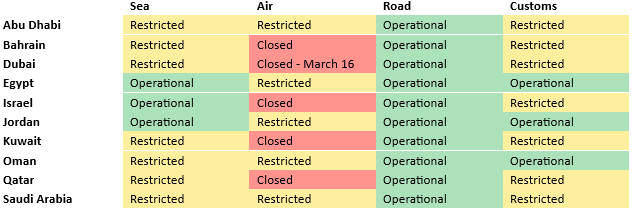
What impacts all modes of transport (air, ocean, trucking) is the oil price as it represents a major cost of their operation – where we have seen a spike.
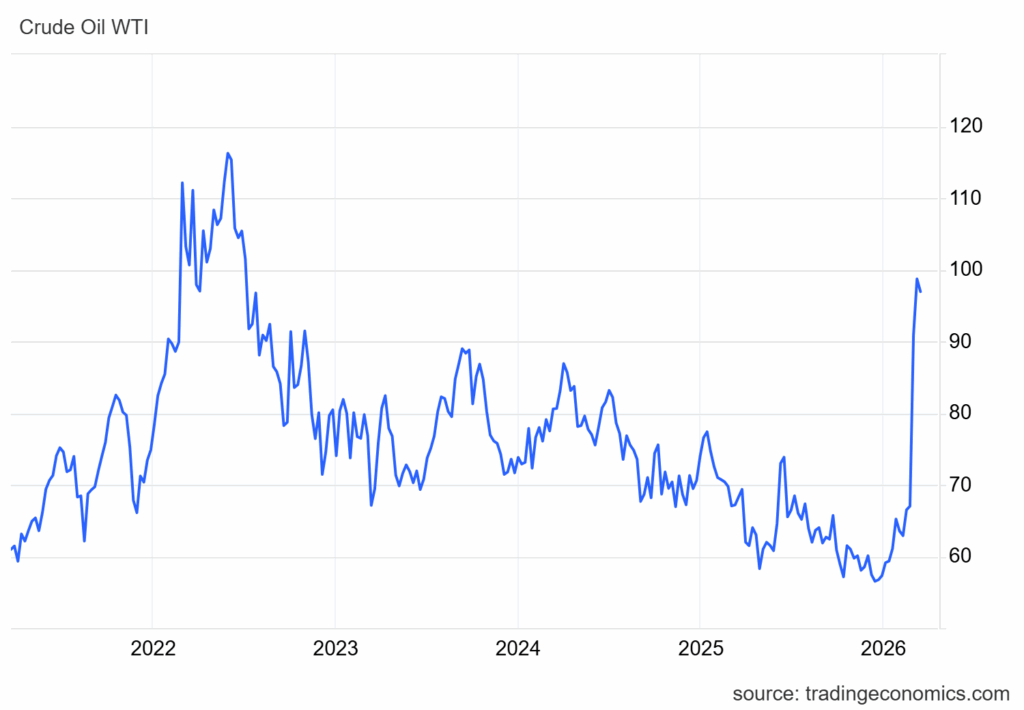
Air freight update
Multiple sources confirm dramatic increases linked to airspace closures & capacity loss.
Key figures:
- Global airfreight rates up 6% week on week in early March, +3% YoY.
- Rates on South Asia → Europe lanes up as much as 70% since start of conflict.
Freightos Air Index:
- China → N. Europe +7% weekly
- China → N. America +2% weekly
- Europe → N. America +3% weekly
Indicative estimate vs. 28 Feb baseline:
- +20–40% globally, +50–70% on lanes using Middle East corridors.
Ocean freight update
Overall increases:
- Container rates have surged 14.9% week over week and 28.3% since just before airstrikes on Feb 27 based on SCFI index movements.
- Middle East lane rates up 40.8% in one week.
- War Risk Surcharges (WRS) applied by major carriers: USD 1,500–4,000 per container (global carriers including CMA-CGM, MSC).
If you look at the container freight rate index over time – you can see that we are way below Covid levels:
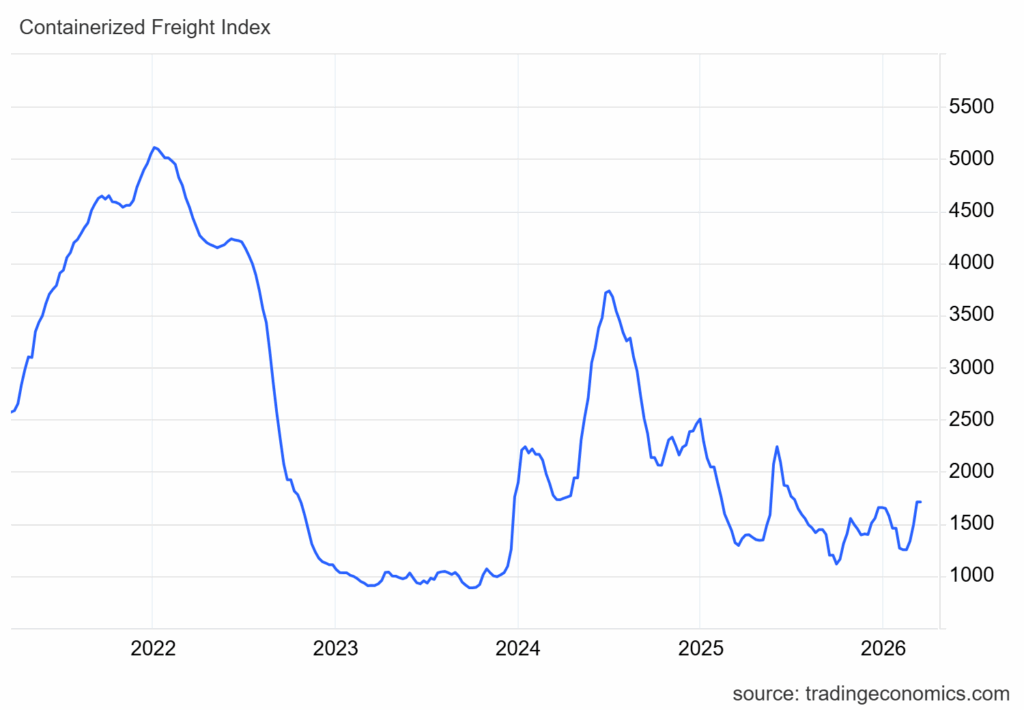
Trucking/Road freight
War impact is primarily through diesel and energy markets.
Key figures:
- Diesel across EU spiked above €2/litre with strongest weekly jumps of 2026.
- Fuel spikes drive immediate cost increases; bunker fuel jumped 8.9% in one week, signaling broader transport cost escalation.
- European contract trucking rates were already rising due to capacity & driver shortages pre-war.
Indicative estimate vs. 28 Feb baseline:
- +8–12% trucking cost increase directly attributable to war driven fuel spikes.
Impact on logistics & supply chains
These developments are affecting global freight flows:
Air freight update
Current situation
- Several airlines have suspended services and stopped accepting cargo to key Middle East destinations.
- Airspace restrictions are forcing airlines to reroute flights, increasing transit times.
- Available airfreight capacity has been significantly reduced across the region.
- Major regional hubs including Dubai, Abu Dhabi, and Qatar are operating under restricted schedules.
- Air freight rates are increasing due to reduced freighter capacity and longer routings.
- War risk surcharges and fuel surcharges are being applied by several carriers.
- Spot rate volatility is expected for urgent and premium shipments.
Customer impact
- Customers may experience limited space availability and delays.
- Transit times may increase due to rerouting and operational constraints.
- Upward pressure on spot rates.
- Possible schedule adjustments and longer transit times.
Ocean freight update
Current situation
- Carriers continue to avoid the Red Sea and Suez Canal due to ongoing instability.
- The Strait of Hormuz is fully closed to commercial shipping.
- Vessels are being rerouted via the Cape of Good Hope, increasing transit times and operational costs.
- Major shipping lines have paused or adjusted services in the Gulf region.
- War Risk and Emergency Conflict Surcharges have been introduced.
Customer impact
- Extended transit times (Cape routing may add 10–15 days).
- Schedule disruptions.
- Equipment imbalances.
- Additional surcharges for Gulf and Red Sea cargo.
- Temporary booking restrictions on selected Middle East destinations.
- Potential cargo redirection to alternative ports for final delivery.
Fuel market developments
Energy markets have reacted strongly to the escalation in the Middle East.
- Fuel prices have increased sharply, putting additional pressure on airline operations.
- Oil prices have risen significantly amid concerns about supply disruptions and restricted shipping through the Strait of Hormuz.
- Brent crude briefly surged above $100 per barrel before stabilizing at elevated levels.
- Fuel markets remain highly volatile, with potential implications for aviation fuel, diesel, and bunker prices.
Expected impact
- Potential BAF (Bunker Adjustment Factor) increases
- Higher airline fuel costs affecting airfreight rates
- Upward pressure on overall logistics cost

